Let There Be Lamps: Dispatches From the Overhead Light Resistance
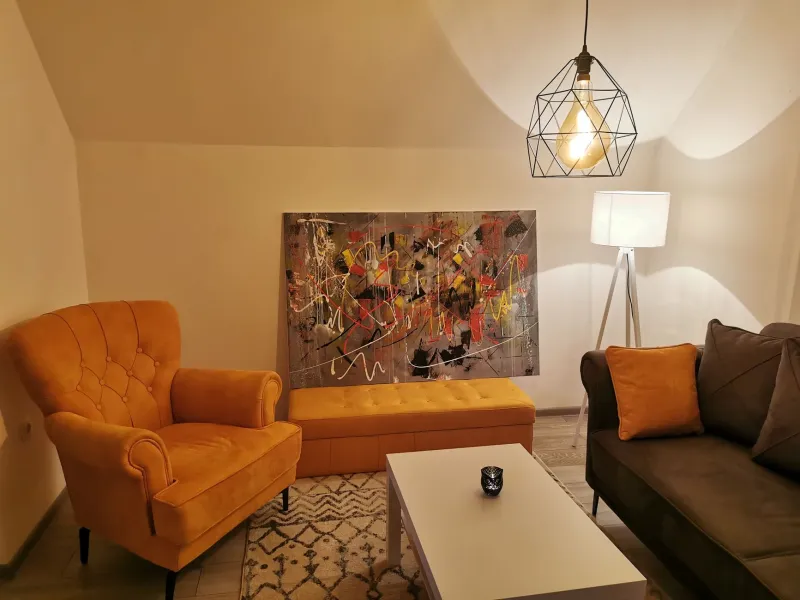
There is a moment, in every shared house, when someone reaches for the ceiling switch and the room goes quiet in a very specific way. Not the quiet of a joke landing badly. The quiet of a small moral tribunal convening. Someone exhales through their nose. Someone else says "oh, we're doing the big light, are we?" and the evening is never quite the same again.
We need to talk about the big light. Not because it has done anything wrong, but because it has been quietly radicalised. The humble overhead bulb — the one that came with the flat, the one that has never asked anything of anyone — has become the most divisive object in British domestic life. More divisive than the thermostat. More divisive than whose turn it is to buy milk. More divisive, arguably, than the dishwasher-loading question, which at least has the decency to be about something.
The Lamps-Only Inquisition
If you have spent any time on the internet in the past few years, you will have encountered the lamps-only movement. It presents itself as a design philosophy. It is, in practice, a personality test with mood lighting attached. The doctrine is simple: the overhead light is vulgar, the overhead light is the lighting of a dentist's waiting room, the overhead light is what people who don't understand hygge use to find the remote.
In its place, an elaborate ecosystem of floor lamps, arc lamps, salt lamps, lamps shaped like mushrooms, lamps that require an app, and at least one lamp that is technically a candle but was $85 so we're calling it a lamp. The result is a room lit like the inside of a small, expensive cave. Everything is warm and diffused and slightly unknowable. You cannot find your keys. You cannot read a book. You are, however, extremely relaxed about both.
And here is the clever bit: the lamps-only crowd have framed this not as a preference but as a virtue. To use the big light is to be insufficiently thoughtful, insufficiently gentle, insufficiently evolved. It is, in the grammar of the shared house, an accusation.
A Brief History of Being Told How to Sit in Your Own Lounge
The strange thing is that nobody was having this argument twenty years ago. The ceiling light was simply the light. You came home, you flicked the switch, you got on with your evening. There was one lamp, probably in a corner, probably with a fringed shade, and it was for atmosphere, in the way that a decorative bowl of potpourri is for atmosphere — present, ignored, mildly dusty.
Then came a decade of interiors content, and with it the great re-education. Instagram taught us that a room should have "layers of light". Pinterest taught us the phrase "ambient glow" and we have never recovered. Suddenly the ceiling rose was a crime scene, the pendant shade was an embarrassment, and the phrase "we never use the big light" was being deployed on first dates as a form of moral signalling. It's the domestic equivalent of saying you don't own a television: technically informative, socially exhausting.
What's interesting is how quickly this became an identity. We no longer say "I like a bit of warm lighting." We say "I'm a lamps person." As though the position of the bulb were a hill one might be prepared to die on. As though there were a lamps-only manifesto, and a membership card, and possibly a newsletter.
The Passive-Aggressive Physics of the Shared House
In a house of one, the big light question is a private matter of conscience. In a house of four, it is a cold war.
The lamps-only devotee will not simply say "could we switch off the overhead?" That would be too direct, and directness is not how the British manage shared space. Instead, they will arrive in the room, flick on a floor lamp, flick on a second floor lamp, arrange both at angles suggesting warmth and sophistication, and then sit down and look pointedly at nothing. The overhead light hums on above them like a snooker hall. Nobody says anything. Everybody notices. Somebody's tea goes cold.
Alternatively, the big-light partisan — usually the one who actually pays the electricity bill, or the one who has to find things — will simply flip the switch on their way through and enjoy a brief, glorious moment of clarity before the sigh arrives from the sofa. That sigh is the entire argument. It contains multitudes: the accusation, the resignation, the silent filing of a grievance to be raised during an unrelated row about bins in February.
There is no resolution to this. There is only escalation. Someone buys a dimmer switch. Someone else buys a smart bulb that can only be operated by an app nobody remembers downloading. Eventually, the room is lit entirely by a series of increasingly arcane sources and everyone is still cross, but now in a softer light.
In Defence of Seeing Things
Let me be clear about where this publication stands, which is under an unapologetic sixty-watt bulb, squinting, content.
The overhead light is the most honest piece of technology in your home. It does one job. It does it without a subscription, without a firmware update, and without asking you to consider your emotional relationship with a lampshade. It lights the room. All of it. Including the corner where the ironing lives and the shelf where you've stacked the post you're definitely going to deal with.
The lamps-only people will tell you that the big light is "harsh". They will tell you that it is "unforgiving". What they mean is that it is truthful. It reveals the dust, the crumbs, the state of the carpet, and the fact that the room is being lit by one bulb and a lot of hope. Soft, layered lighting is not a design choice. It's a way of not looking at your own skirting boards.
And yet — and this is the tragedy of the whole affair — we cannot quite let it go. Because the moment someone suggests the big light might be fine, actually, a small part of all of us recoils. We have internalised the judgment. We have been trained, by a decade of curated rooms and app-controlled warmth, to feel something when the ceiling switch goes on. Something like shame, but with better shadows.
The Light at the End of the Argument
So where does this leave us? Presumably exactly where we were: two factions, one switch, and a shared house that will never be fully at peace.
The sensible compromise, as ever, is to accept that the big light is a tool and not a moral position. Use it to find your keys. Use it to hoover. Use it when the fog rolls in and you need to see whether that thing on the kitchen floor is a grape or a slug. Then, when the plates are cleared and the evening softens, flick it off and let the lamps do their expensive, flattering work.
That is the settlement. That is the peace treaty. Neither side will sign it, of course, because both sides have invested far too much in being right about a ceiling. But it's there, if anyone wants it.
Until then, we'll be in the front room, under the big light, making eye contact. Do come in. There's a lamp if you'd rather.