Your Ticket Is a Receipt Now: The Slow Death of the Museum Day Out
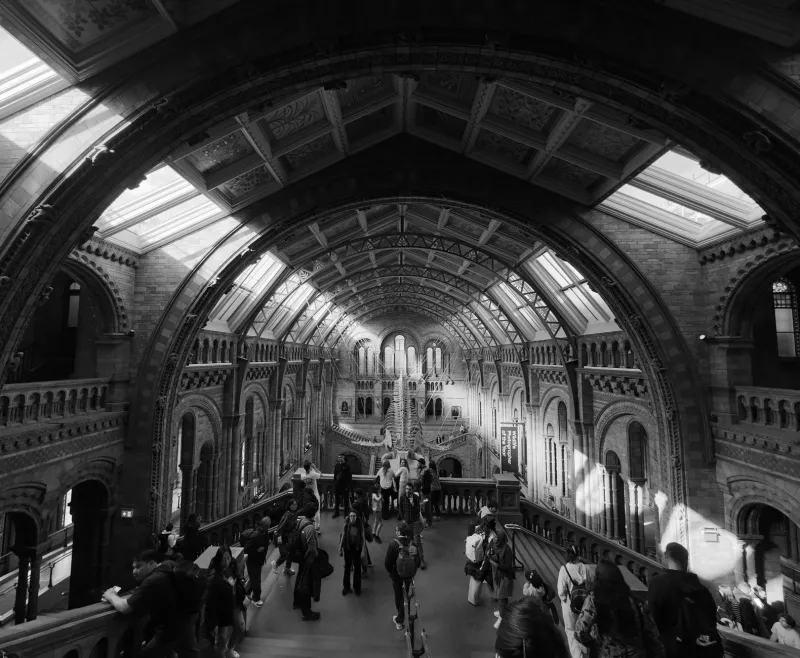
There is a moment, roughly ninety seconds after you clear security at a major British museum, when you realise you have not actually entered the museum. You have entered the queue for the museum. Ahead of you: a family consulting a printed floor plan like it's a treasure map, a man filming a twelve-second video of a dinosaur skeleton he will never look at again, and a sign directing you to the gift shop with the urgency of a fire exit.
The art, the artefacts, the actual reason you came — these are technically available. They are just no longer the main event. The main event is the logistics of being near them.
Timed Entry, Untimed Disappointment
Book a slot. That's the first instruction, always. Ten-fifteen or eleven-thirty, and God help you if you arrive at eleven-thirty-one, because the nice person at the door will explain, with the apologetic firmness of a bouncer at a provincial nightclub, that your window has closed.
We have accepted this. We have accepted that a free museum now requires the scheduling discipline of a budget airline, and we've accepted it because the alternative is queueing outside in November with a thermos and a sense of shame. What we have not accepted, or perhaps have not noticed, is what the timed slot does to the visit itself. It turns a wander into an itinerary. It turns curiosity into throughput. You are not there to get lost in a room of Roman coins for forty minutes; you are there to be processed through the building at a rate the gift shop can sustain.
And the shop, let's be clear, is thriving. It is the only part of the experience without a queue that moves.
The Catalogue Costs More Than Your Lunch
There is a particular kind of exhibition — usually "immersive", usually involving a projector, some sunflowers and a soundtrack of dubious authenticity — where the ticket is £24, the catalogue is £18, and the actual artworks are reproduced at a size that makes you squint. You are paying for the atmosphere of culture rather than the inconvenience of it.
I don't entirely blame the institutions. Buildings cost money, roofs leak, and the funding settlement has been what it's been for fifteen years. But there's a difference between selling a tote bag to keep the lights on and designing the entire visitor journey around the tote bag. The difference is the members' queue.
Have you seen the members' queue? It is a separate, faster, faintly smug corridor past the rest of us, and it tells you everything about how the museum now understands itself: not as a public collection held in trust, but as a membership scheme with some artefacts attached.
The Immersive Exhibition Is a Screensaver With a Gift Shop
The rise of the "immersive" show deserves its own paragraph of quiet contempt. You sit on a beanbag in a warehouse in a business park, Van Gogh's sunflowers are projected onto three walls at low resolution, and somewhere a speaker plays something meant to be moving. It costs the same as a decent dinner. There is no original work in the room. There is no room, really — just a large, dark rectangle with a gift shop at the end.
And people love it, which is fine, because people also love a lot of things. But we should be honest about what it is: it is a screensaver with a merchandise licence. It is the culture equivalent of a scented candle named after a city you've never visited.
Field Notes: How to Find the Actual Art
A short, practical guide, written by someone who has failed at this repeatedly.
Go early or go late. The two hours after opening and the last hour before closing are the only times a major museum feels like a place rather than a conveyor belt. Everything in between is a school trip with a mortgage.
Ignore the recommended route. Every museum now hands you a suggested path, and that path goes directly past the shop. Walk the other way. Get lost. The best rooms are always the ones with the hard chairs and the bad lighting, where a single case of Saxon brooches sits unbothered because there's no interactive screen attached.
Say no to the audio guide. It is £5, it is narrated by an actor doing a voice, and it will keep you in the gift shop's gravitational pull for an extra forty minutes.
Eat before you arrive. The museum café is now a restaurant with a museum attached. A sandwich is £9.50 and the queue is longer than the one for the Egyptians.
Leave by a side door if you can find one. Some museums still have them. They are the last unmonetised square footage in Britain.
Proof of Presence
Here's the thing I keep circling. We used to go to museums to look at objects and come away with a vague, unearned sense of having learned something. Now we go to acquire evidence — a photo, a receipt, a tote bag that says TATE in a font that says "I have opinions about Brutalism". The culture has become the pretext for the souvenir.
Maybe that was always true. Maybe the Victorians were just as bad, and the difference is that their gift shops didn't have contactless payment. But there is something newly bleak about a day out that ends, without exception, at a till.
The museum is still free. It's just the leaving that costs you.